

In parks, at school and even in companies, you've probably already seen these gatherings of people doing series of exercises for several minutes.
And for good reason: it's a practice perpetuated by the Japanese for decades and strongly encouraged by the government. This is "rajio taisô".
Where does this practice come from?
Morning gym (and not only) has been a habit in Japan for almost 100 years. From the 1920s, following the enthronement of Emperor Shōwa, the country sought to unify its people around gatherings and events that could be followed by everyone.
Without delay, in 1928, the Ministry of Health and Welfare looked into the project of daily radio broadcasts offering physical training within everyone's reach. This idea was clearly inspired by what was being done on the American side, where the insurance company Met Life included fitness exercises in its radio advertising spots.
The aim is to make physical exercise accessible to all, whatever the age and condition, thanks to easy movements that can be done from anywhere.
That's when "rajio taisô" was born, which can be translated as "radio calisthenics", and whose objectives are most clear.
From radio to TV
Every morning, at 6:30 am, the radio channel NHK Radio 1 has broadcast, since 1928, a common routine of sports sequences to wake up and tone the people. And this 10-15 minute appointment is now part of the habits of many Japanese.
So much so that the main objective of bringing the population together seems totally achieved. For decades, families, groups of friends, and even strangers in public places, have come together to perform the dictated exercises.
With the appearance and spread of television, the practice even strengthened, since in addition to the sound, you now have access to the image, making it easier to understand the exercises in order to reproduce them.
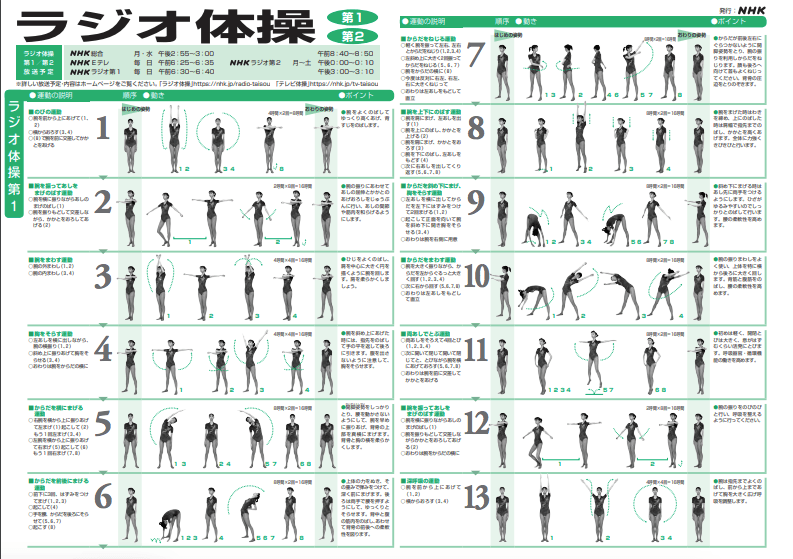
NHK also puts the explanation of each of these movements in a PDF accessible online, and here's an extract:
No more excuse not to move
Faced with the enthusiasm, the exercises that were initially morning ones turned into recurring appointments throughout the day. You'll find up to 4 sports slots a day on NHK's TV and radio channels.
These multiple broadcasts notably aim to let everyone find the best moment in their day to do a little sport. Despite work and the hustle and bustle of daily life, everyone can benefit from at least 10 minutes of sport to fit into their schedule.
The elderly and children aren't left out either. As for the elders, we notice that they are the ones most in the habit of gathering to practise together, early in the morning. The practice of this gym is even sold as one of the secrets of the Japanese's longevity, and of their good shape. For children, the programmes adapt notably to school holidays to offer them dedicated shows. They can also receive training booklets to validate after each sports session to encourage them.
People with reduced mobility also have access to these programmes, since the exercises are mostly adapted and a seated variant is offered.
Note that these "taiso" programmes are also available internationally via YouTube videos or NHK World Radio Japan. Come on, shall we put on our jogging gear and do a session?


