

While The Great Wave off Kanagawa is one of the best-known works of the artist Katsushika Hokusai, it should nonetheless be noted that this painting is part of a series, the Thirty-six Views of Mount Fuji, whose central subject is the famous Japanese mountain.
Let's discover it!
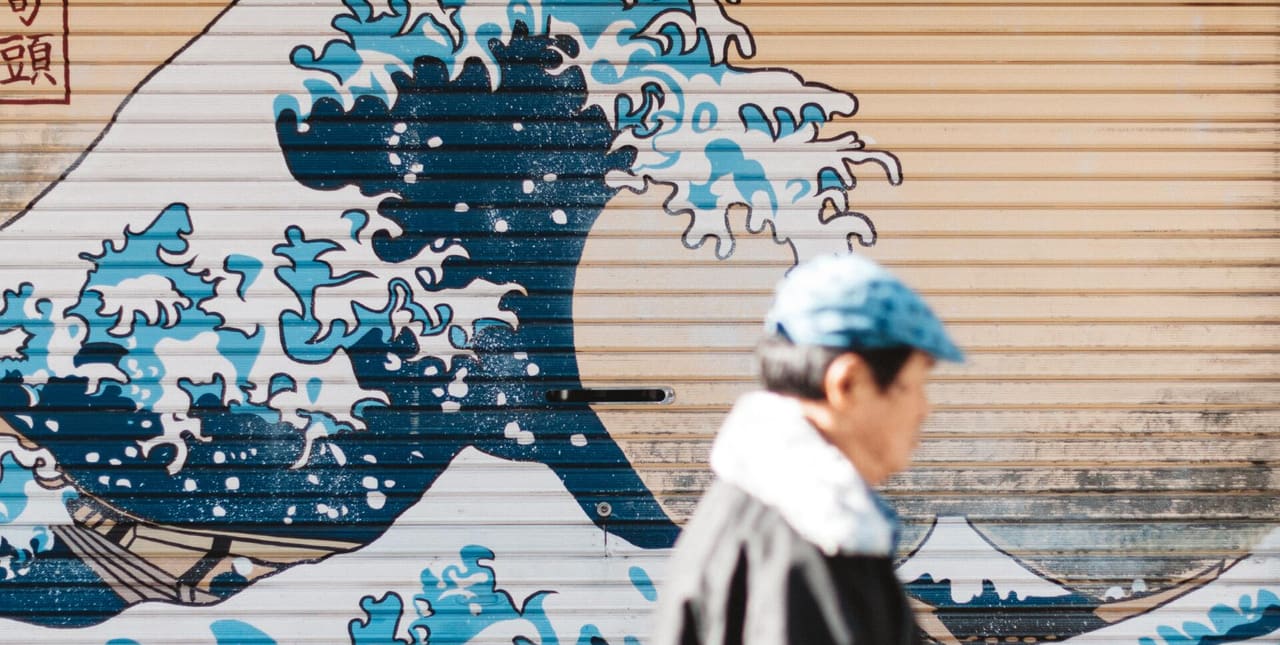
The artist: Katsushika Hokusai
Katsushika Hokusai was born in Edo, the former name of Tokyo, probably at the end of October 1760 (the dates aren't exact, since the calendars evolved in the following centuries). He's a multifaceted artist, since he distinguished himself notably in painting, drawing, engraving but also in writing.
The artist took an interest in and developed surprising abilities for drawing from his earliest childhood. So much so that in early adolescence, he took his first steps in the artistic world by joining a xylography workshop, which is a multiple-reproduction process using woodcut engraving.
For more than 10 years, he then worked alongside Katsukawa Shunshō, in his workshop. The latter was a painter recognised in the ukiyo-e artistic movement, which mainly uses prints to depict scenes of the living world.
His career took off shortly after Shunshō's death, under the pseudonym Hokusai only. Note that Hokusai would use nearly a hundred different artist names depending on the periods of his activity. Among the best known, the name "old man mad about drawing" will notably be remembered, perfectly representing his all-consuming passion for this discipline.
He would notably publish a travel notebook recounting his adventures during the 2 years spent travelling the Japanese archipelago, under the name Manga. It's here that the term still used today was born.
"If heaven had granted me ten more years of life, or even five, I could have become a true painter"
... that's what the artist is said to have uttered on his deathbed, surely unable to imagine the impact of his works all over the world for the centuries to come.
During his career, Hokusai would produce no fewer than 30,000 drawings inspired by the ukiyo-e movement, of which he is one of the main representatives, if not the most emblematic.
The Thirty-six Views of Mount Fuji
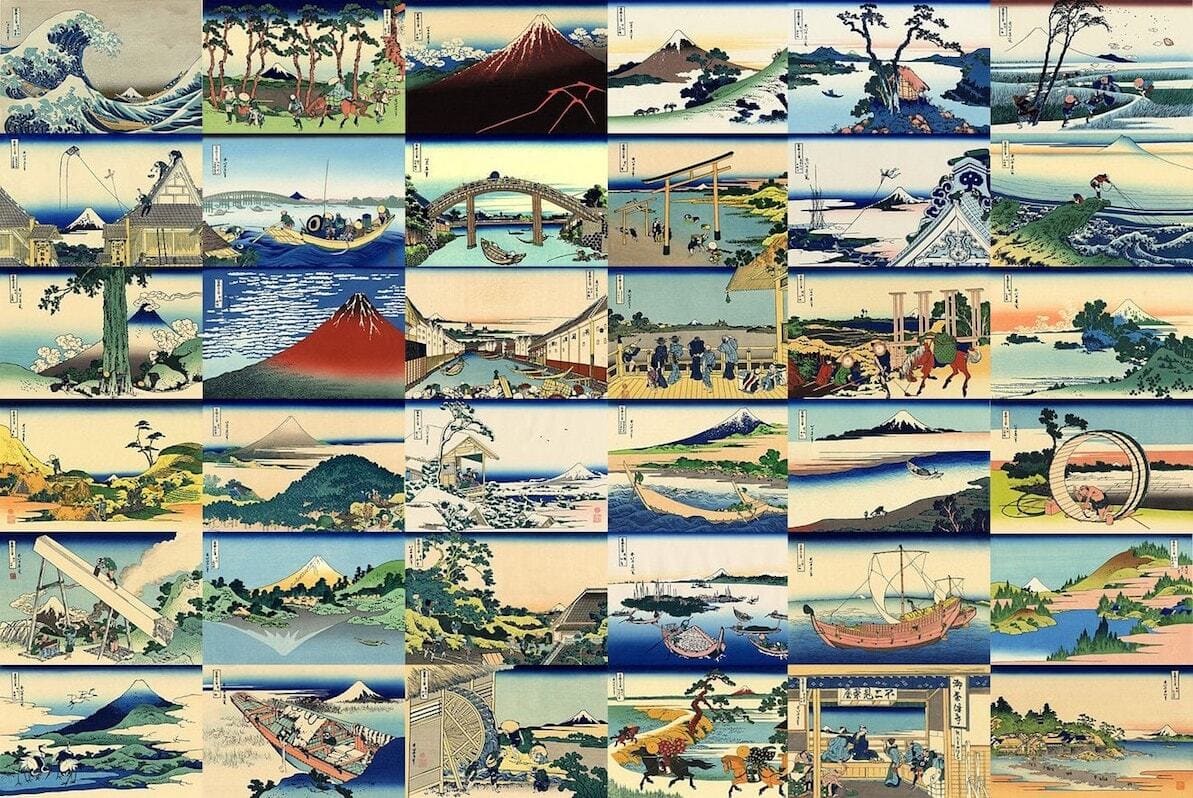
Katsushika Hokusai achieved worldwide recognition thanks to a series of works whose main subject is Mount Fuji, the best known of the Japanese mountains.
Named the Thirty-six Views of Mount Fuji, this series is in fact made up of 46 pictures. The most accurate term would moreover be prints, since that's the technique mostly used. A print is an image produced thanks to a board engraved beforehand (with the desired motif or drawing), then coated with ink before being applied to a support (paper, fabric, etc.).
Fitting perfectly into the ukiyo-e movement, since it depicts fleeting scenes of the world, of nature or of daily life, this series precisely makes it possible to establish landscapes as real subjects in Japanese painting. Mount Fuji is depicted there from different angles and from different points of view.
These variations in angle are precisely the fruit of the artist's daily learning. Travelling across the peninsula and joining different schools, Hokusai experimented with the Western perspective techniques he would therefore use in the 46 works of the series.
This technique allows these engravings to stand out and reach the rank of undeniable masterpieces. But another distinctive element catches the attention: the colours used, and notably this predominance of blue. A so-called "Prussian" blue, since imported straight from the Netherlands and used for its good resistance over time.
These 36 views are probably the oldest depictions of the current version of Mount Fuji, although they were published between 1831 and 1833.
An influence, still current.
Many more contemporary artists have cited Hokusai and his work as a source of inspiration for their own productions. This is notably the case of great European painters such as Monet, Van Gogh and Gauguin.
Hokusai would have completely upended and left his mark on Japanese culture, and mainly the artistic movement called Japonism. To pay tribute to him, two museums were created. The first as early as 1976 in Obuse, the Hokusai-kan museum. Then more recently, in 2016, in Tokyo, on the spot where the artist's workshop stood — where he would ultimately spend his whole life despite his many journeys across the country.
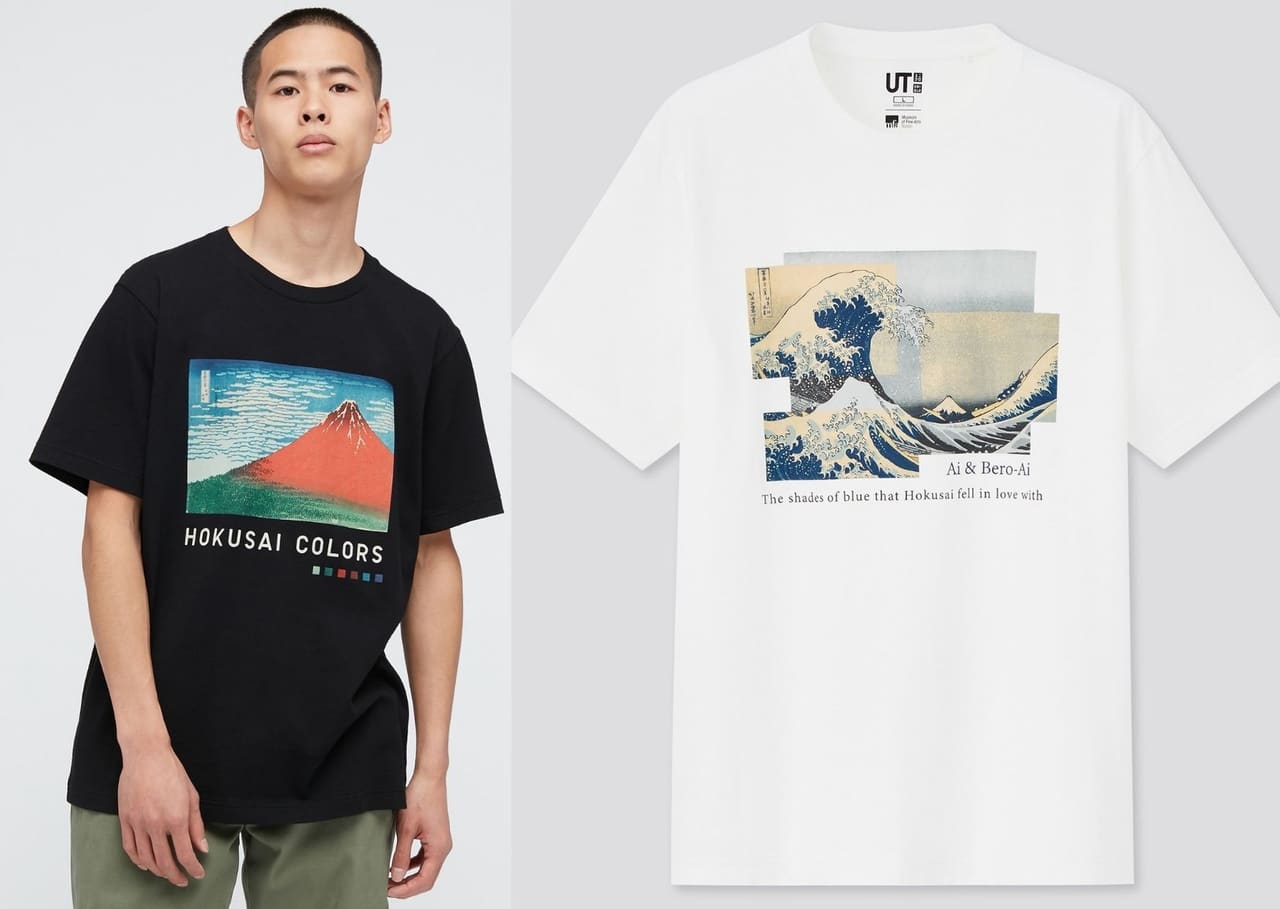
The influence of Hokusai's prints goes beyond the borders of painting, since these motifs are found notably in various fashion collections. Several ready-to-wear brands, fast-fashion as well as haute couture, have adorned their pieces with the artist's drawings. The latest example: the global brand (but also of Japanese origin), Uniqlo, which put on sale t-shirts where the works are proudly displayed in several colour variations.


