A little less popular (for now) than the maki or the sushi, the onigiri is nonetheless taking up more and more space on Japanese restaurant menus. And for good reason: both cute and fun, it's also recognised for being tasty and filling.
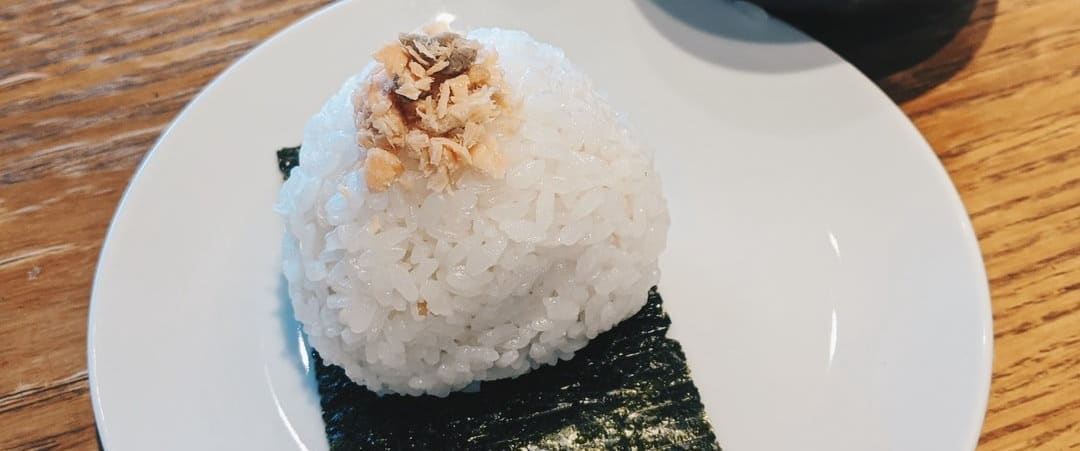
Sometimes called omusubi, this preparation, originally made only of rice, now wears a sheet of nori seaweed and holds a most flavourful filling at its heart.
Let's discover the secrets of the onigiri.
Original bites
Traces of the onigiri, in its first version, are found as early as the Nara era (between 710 and 794). At the time, mention is made of portions of rice that can be eaten without chopsticks and thus grabbed with the fingers. Crossing the centuries, we also know that the samurai ate this type of bite, quickly between two battles, notably to regain their strength.
Produced by hand only for a very long time, with a precise method, a first machine to create onigiri in large quantities was invented in the 1980s. This invention follows the enthusiasm around this food, since it's now one of the Japanese's favourite snacks. Beyond their sale in most small grocery stores (called konbini), onigiri have their own shop: the onigiri-ya.
If the onigiri is so appealing, it's notably because of its appearance. This rice bite originally comes in 4 shapes:
- triangle (sankakukei), the most widespread
- ball (bōrukei), thus echoing its original shape
- "straw bale" (tawarakei), long and rectangular
- "drum" (taikokei), which looks like a patty
But nowadays, creativity and accessories have meant the onigiri takes on a multitude of appearances and shapes. This is notably the case when you want to make a kawaii bento or prepare original snacks, for children for example. Many accessories in various shapes (characters, flowers...) make it possible to form bites by filling them with a layer of rice, then a ball of filling before adding rice again and compacting it all. Guaranteed result!
Finally, there's a grilled version of onigiri: a few minutes on each side and you get yaki-onigiri, terribly crunchy.
So practical!
Although the onigiri is very widely eaten, it's nonetheless considered only a "snack" and very rarely an element of a meal. That's the type of consumption that has always been attributed to it and that remains, even today, anchored in habits. Like our sandwich, our ham-and-butter baguette, the onigiri is more part of picnics than grand dinners.
It's its practical side and its format that have, of course, fed this habit. Eaten with the fingers only, not bulky, it's easy to carry. At the office, outdoors... but mainly on the go.
If we look at its composition, it's once again the ideal alternative for a quick boost. Hearty and rich, it's now made of rice and a filling, all placed on a piece of edible seaweed, the nori. The first recipes incorporated fillings that were very often salty, acidic or sour, which the rice ultimately came to "calm".
Nowadays, the variations in terms of taste are multiple, but you'll mostly find fillings based on: salmon, tuna, eel, umeboshi (a salty preparation made from plum), seaweed, nozawana (a Japanese radish), uni (sea urchin), cheese, pulled pork or beef.
Always a treat, it's now time to learn how to make them yourself...
Simple onigiri recipe
Like a craving for freshness with spring arriving — that's why we're offering you a tuna and cucumber onigiri recipe to slip into your next picnic basket.
👥 serves 4
🥣 25 min preparation
🕒 10 min cooking
Ingredients
200 g Japanese rice
1 tin of tuna in water
1/3 of a cucumber
4 tablespoons vinegar
4 pieces of nori seaweed
Soy sauce
Method
- Soak the rice in a bowl of cold water for 1 h.
- Let the rice drain for 30 min in a colander.
- Pour the rice into 20 cl of water, bring to a simmer and cook over medium heat, covered, for 10 min.
- Remove from the heat and let rest for 10 min, still covered.
- Pour the rice into a bowl and add the vinegar. Mix and let cool.
- Cut the cucumber into cubes.
- Mix the cucumber cubes and the tuna with a little soy sauce.
Assembly
- Form rice balls with moistened hands
- Pack the rice in the hollow of your hand
- Add a little filling
- Close the rice ball so it's compact
- Flatten the ball to give it a triangular shape
- Place the triangle on a piece of nori seaweed