

They've made their entrance on the menu of your Kajiro Vienne & Roussillon restaurants — ramen is now an emblematic Japanese dish.
But did you know it's not really originally from Japan? That there are a multitude of base recipes? You're going to learn everything about ramen.
A Japanese speciality, really?
Careful, disappointment ahead for many of you, but ramen isn't originally a dish from Japan. This speciality comes from China and was imported to the Land of the Rising Sun during the Meiji era, at the very end of the 19th century. Chinese immigrants thus brought the recipe for this delicious broth with them, and we see the first ramen restaurants open in the port city of Yokohama as early as 1910.
The base ingredient of the recipe was the rice noodle, but the Second World War somewhat changed consumption habits. At the time, Japan lost several territories (including Taiwan) and faced a terrible rice shortage. Rationing was strict and the population lacked food. On their arrival, the Americans imported wheat en masse, pushing the Japanese to adapt. Rice-based noodles thus became wheat-based noodles.
Getting around the rationing rules thanks to the black market, several vendors roamed the country's streets with their "yatai" (mobile shop), allowing them to cook ramen and sell it to the hungry population. It's through this process and with this historic crisis that ramen would become so popular throughout the archipelago.
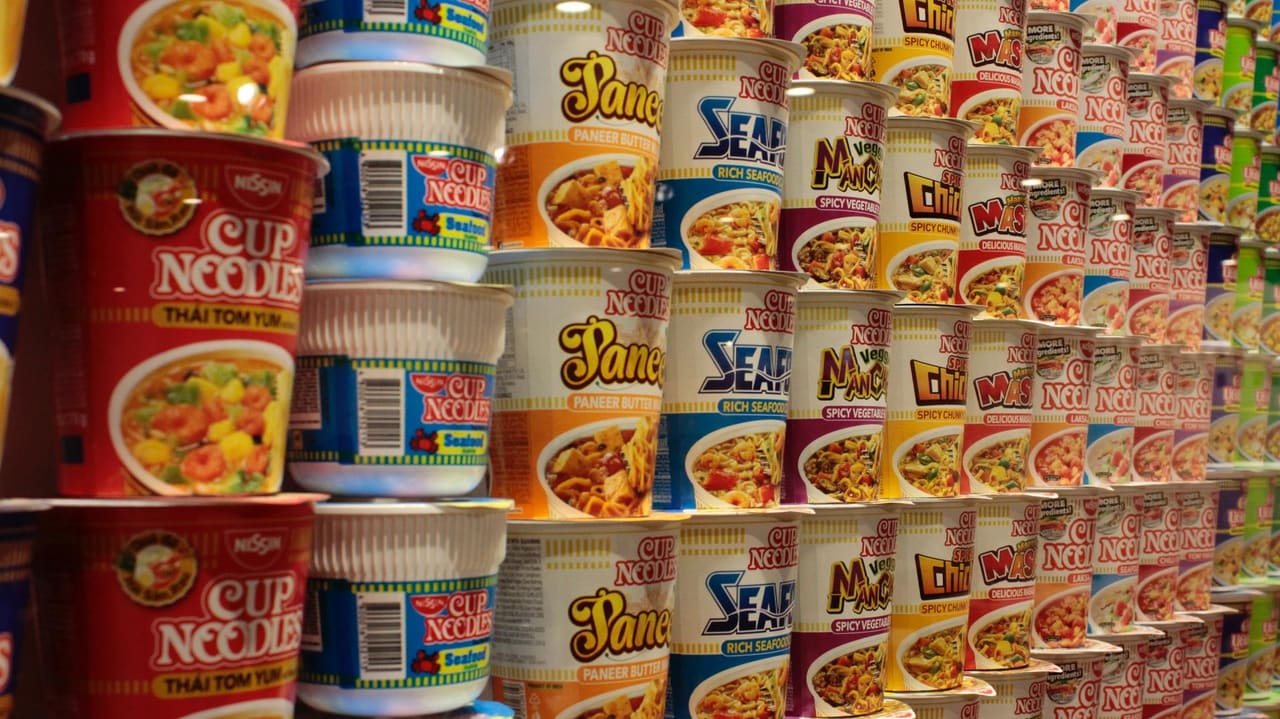
Ramen crosses time and follows the progress of the food industry. In 1958, the multinational Nissin Foods was the first to market the revolutionary concept of instant noodles. Ramen could thus be enjoyed away from home, with a little boiling water and the famous dehydrated powder giving the broth its taste. 1971 marked a new turning point, since McDonald's set up in Japan. As a response, and to keep maximum exclusivity with local food, the legendary Cup Noodle was launched.
Ramen has become an institution in Japan, to the point that a museum is dedicated to it. The Shin-Yokohama Rāmen Museum, in Yokohama naturally, opened in 1994 and is still active today.
Its success: its composition!
Simply put, ramen is made of noodles served in a flavoured broth and garnished with generous pieces of meat or fish, seaweed, fermented bamboo shoots, spring onions, etc. But what about each element?
The noodles
As stated above, while they were initially rice-based, it's now wheat noodles that are most widespread. These, outside industrial production, are stretched by hand by the cooks. Depending on the regions of the country or the world, they're more or less thick. This is also the case depending on the ramen recipe offered.
For the recipe, it's only flour, water, salt and kansui (an alkaline water that gives the noodles their colour and consistency).
The broth
The broth in which the noodles bathe remains one of the elements that brings the most taste to the preparation. We can distinguish 4 main ones:
- Shoyu, based on soy sauce. It uses the salt broth of the ancestral Chinese recipe, to which the Japanese added one of their specialities, soy sauce. It's mainly served with meat, notably pork slices, but also with beef or chicken
- Tonkotsu, the least light broth of the four. The broth is indeed thicker and more fragrant because it's made from pork bones boiled for a long time (or poultry carcass). It originates from the north of the country.
- Shio, originating from Tokyo. The taste of the preparation is dominated by its salty seasoning. It's the lightest, and the noodles are therefore very thin.
- Miso, relatively recent (1960s), whose fermented bean/soy paste gives the broth a thick consistency and a brown colour.
But these four ramen "families" aren't the only ones to win people over. There are also broths based on curry, seafood... and even ramen without broth in some cases! Enough to leave the most fanatical rather dubious, we understand.
The topping
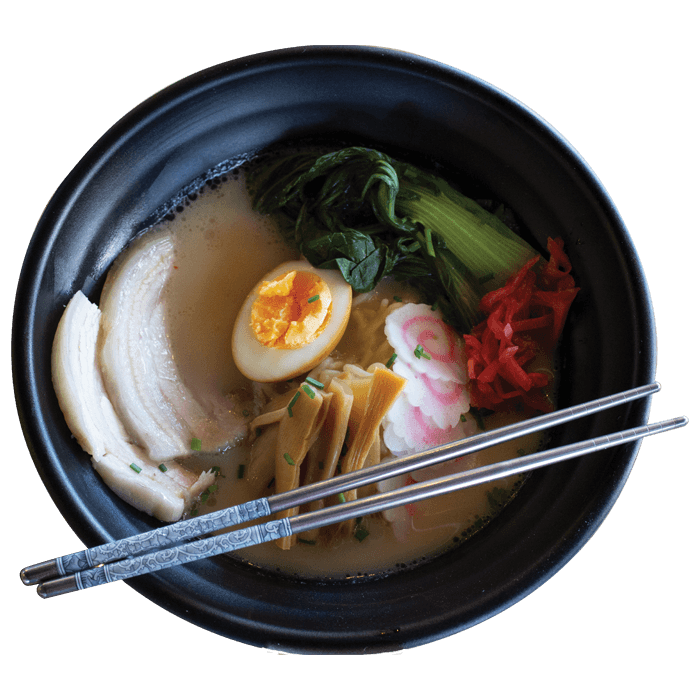
Among the most recurring garnishes are mainly meat, notably chāshū pork (braised pork pieces), but also beef and chicken. For fish, it's of course salmon and cooked tuna that prevail, but let's note the very visual presence of narutomaki pieces. These are those white shapes with pink spirals whose taste resembles surimi. Finally, to finish on the protein side: the egg. The latter is most of the time soft-boiled and marinated in a soy sauce broth.
You can also count chives, garlic, mushrooms, corn, bok choy (Chinese cabbage), nori sheets (seaweed in which maki are rolled), pickled ginger, fermented bamboo, etc.
Each region of Japan has thus adapted ramen according to local products. And it's the same all over the world. After being exported to the various countries of the Asian continent, ramen won over Asians. So much so that this speciality is transformed to match local tastes. The reinvention of this dish, coupled with the search for originality at all costs, gives the most unexpected combinations. You can thus find: raclette ramen, kebab ramen, chocolate ramen, fruit ramen or even coffee ramen. Shall we give it a try?
Finally...
More than a simple dish, ramen has become an emblem of Japan. Inseparable from the country in pop culture, it has been exported around the world and now comes in a thousand and one ways.
At Kajiro Sushi Vienne & Roussillon, find 7 ramen recipes, each more delicious and comforting than the last. Perfect for the coming winter, isn't it?


