

This Tuesday 29 September, Japan celebrated one of its emblems, the maneki-neko. If the name means nothing to you, you've nonetheless very probably already come across it, and this cat figurine is probably not totally unknown to you.
But where does it come from?
The maneki-neko (招き猫), whose name means "beckoning cat" (lucky cat), was born during the Edo era (1603-1867) in Japan, and more precisely in the middle of the 19th century. The first written traces attesting to its existence are newspapers published in the 1870s. Its popularity grew, since from the start of the 20th century, adverts encouraging the purchase of maneki-neko were distributed.
This statuette, initially in ceramic or porcelain, was apparently widely adopted following restrictions by the Meiji government of the time, which banned talismans evoking sexuality at the entrance of Japanese brothels. The cat with the raised paw more subtly replaced the signals inviting customers to enter.
However, a second hypothesis about its birth also persists and is more widely followed. The maneki-neko would in fact just be a representation of an old Chinese proverb: 猫洗面过耳则客至. The latter, meaning "The cat that washes its face, passing the ear, until the guest arrives", would suggest that having a maneki-neko could attract visitors. As for shops and other public establishments, the idea of attracting customers is evoked.
Each of the animal's paws is also given a connotation depending on the region. Generally, while the left one, raised, would represent invitation, the right one, lowered, would bring wealth and luck.
Even if its "lucky charm" dimension is indeed known in Europe, it seems that in this part of the globe the cat's sign would be more of a "goodbye" to thank the visitor, and not an invitation to enter.
To each element, its symbolism
Its colour
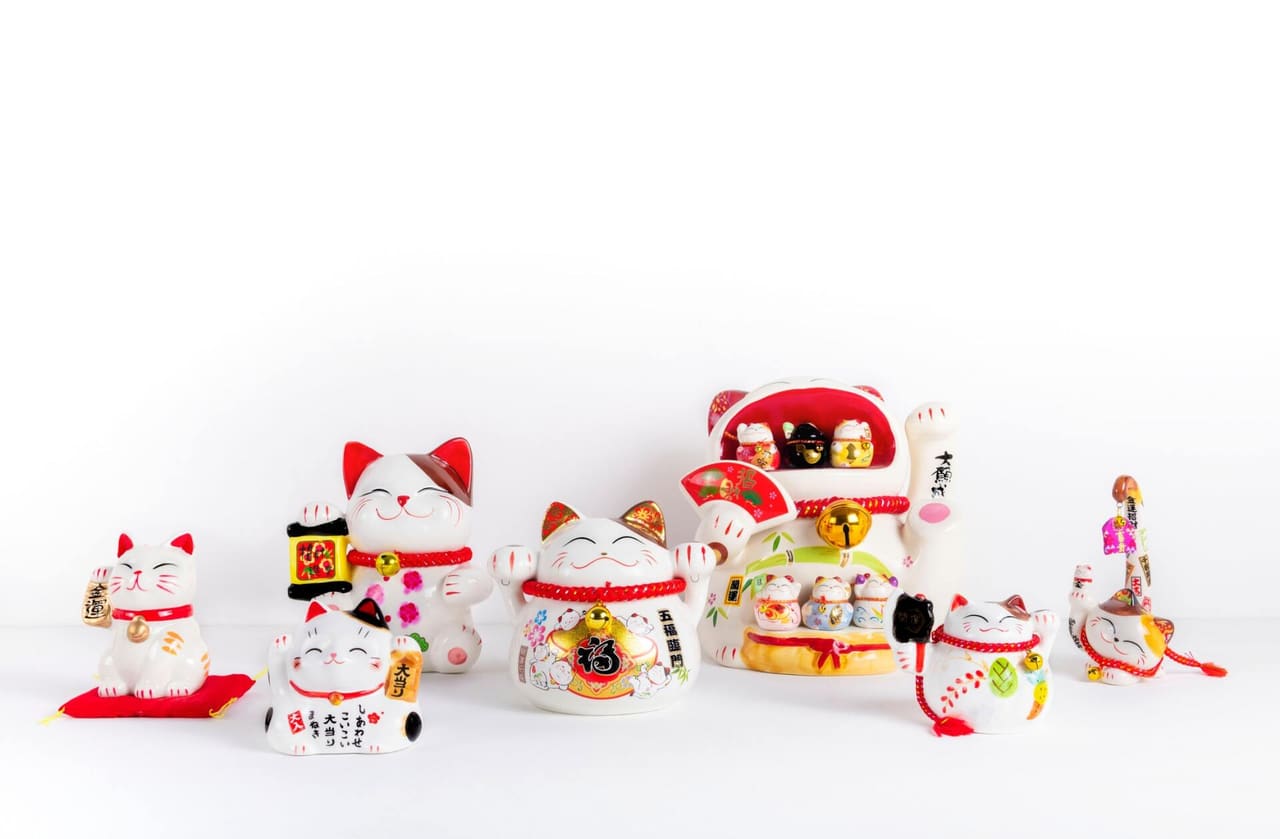
Each element having its symbolism, everything that makes up your maneki-neko statuette could bring you different virtues. This is notably and especially the case with its colour. Although today the cat comes in every colour, for decorative and aesthetic reasons, in the past it was chosen according to the protection one wished to acquire.
The most widespread colours are white, red, gold and tricolour. White, which as in many cultures is synonymous with purity; red, watching over your health; and gold, logically, being associated with wealth. But white cats with black and ginger spots — therefore tricolour, called "triple fur" — are more prized, as they would seem to be the most powerful lucky charm. This idea was born from the rarity of this coat in Japanese bobtail cats.
Nowadays we also find black cats, often owned by women as they bring protection against attackers. Green for academic and university success, yellow for couples, or pink for love more generally.
Its equipment
Largely inspired by the cats of the rich families of the Edo era, the maneki-neko borrows two of their characteristic elements: the red collar and the decorative bib. The wealthy households indeed fitted their pet with these prestigious ornaments. A bell at the end of the collar completed the adornment.
The maneki-neko's "bearer of fortune" dimension is also greatly linked to the large gold coin it can hold in its lowered hand. This coin represents a "koban", a currency used more than 150 years ago in Japan. Just like the piggy bank in France, the maneki-neko was very quickly used as a guardian of savings and was itself fitted with a slot at the back to slip coins in.
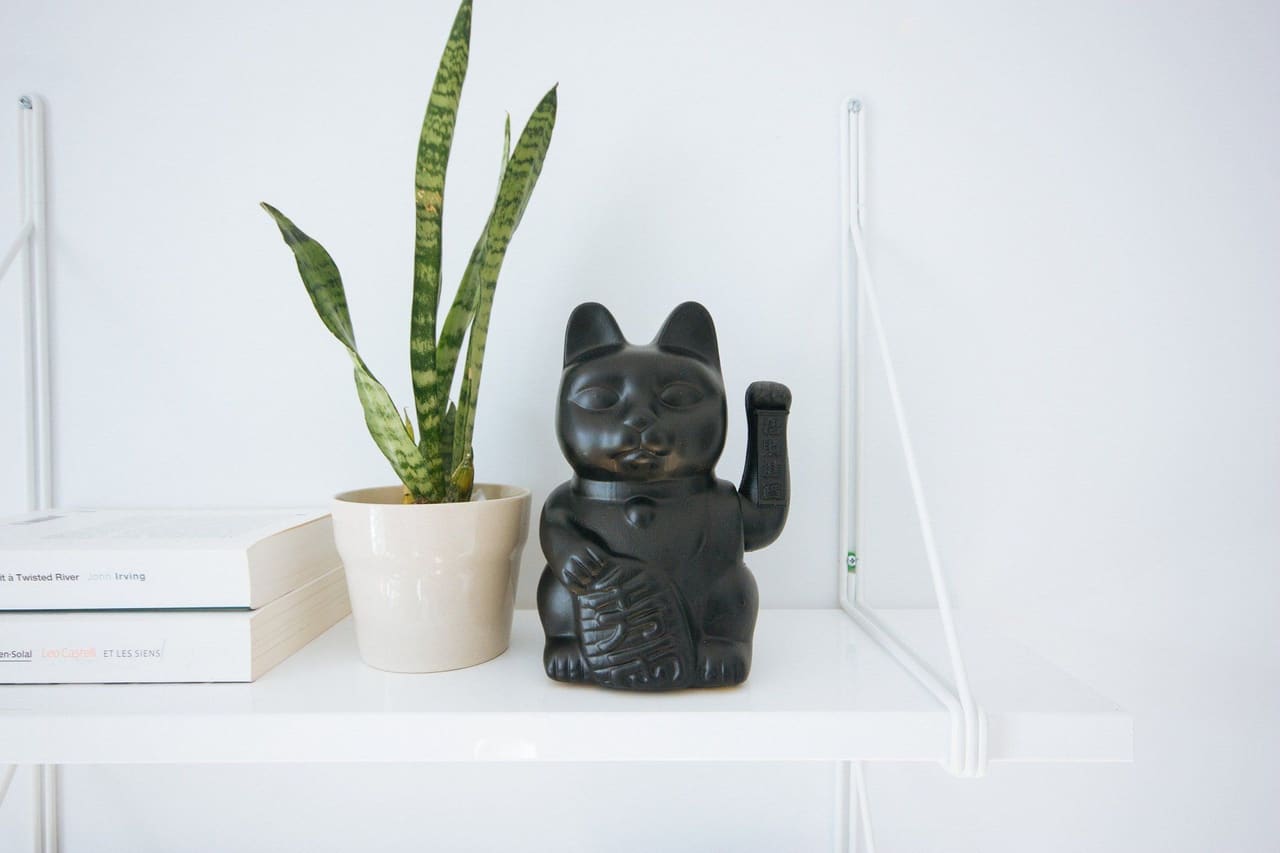
Today a decorative element in homes or in many Asian shops notably, the maneki-neko has nonetheless lost none of its symbolism combining protection and happiness. Many legends are associated with it, as well as a host of virtues depending on its look and design.
Will you take it into account at your next acquisition of this emblematic statuette?


