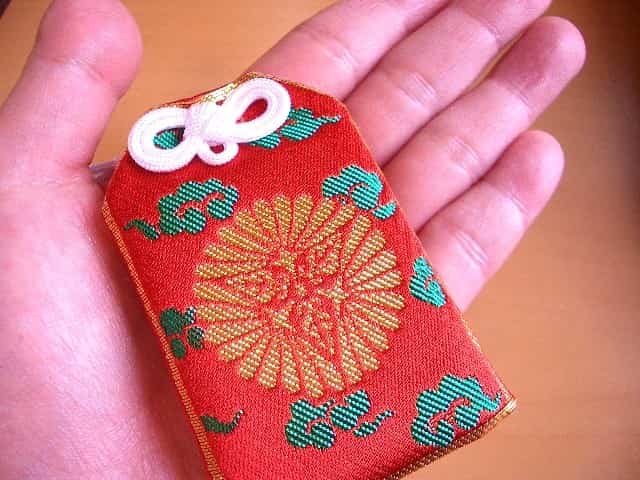
If you're looking for a new, effective lucky charm, it may be time to get yourself an omamori. These Japanese amulets are renowned for offering protection on different levels and for different life events.
To slip into your pocket, your purse or onto a keyring — from now on you can count on this small, protective and benevolent item.
What exactly is an omamori?
Its name points directly to its function: "mamori" indeed means protection. A prefix was then added to make the term honorific, without it losing any of its meaning.
The omamori is originally made of wood and fabric. Or more precisely, it's a small wooden rectangle inscribed with a prayer or positive thoughts, which is then slipped into an embroidered, colourful pouch. Because yes, this amulet comes above all from religion, and notably from Buddhist culture. You'll easily find them, for example, at the entrance to temples during your visits.
The origin of this little good-luck item is said to come from a legend. Susano-o no Mikoto, the god of storms, is said to have been given shelter by a modest Japanese man named Somin Shorai. The latter offered him food, sake and a place to sleep. The god returned to see the man a few years later, this time revealing his identity and presenting him with writings meant to protect him from illness and misfortune, as a thank you.
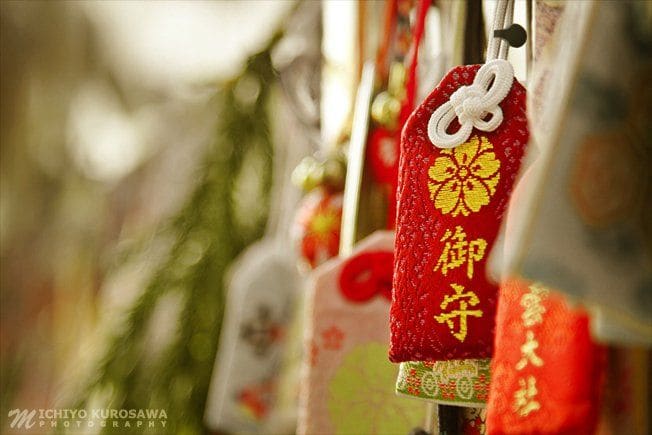
This link with religion is moreover still firmly anchored, as most omamori available at temple entrances bear the name of a deity. However, these amulets haven't escaped the effects of fashion and pop culture, since now the little pouch — initially made of silk — comes, for example, in the likeness of well-known kawaii characters: Hello Kitty, Rilakkuma, Pokémon, etc.
Multiple powers
While it's perfectly acceptable to get an omamori for yourself and ensure your own protection, tradition has it that you offer it to the people you love. It's notably a token of love or friendship. As mentioned above, these can be slipped into pockets or wallets, but also be visible and hung on phones, bags, car rear-view mirrors... Some are even worn only for specific occasions, depending on the protection they guarantee.
Because just like the Maneki-neko, the omamori offers several powers depending on its type:
- kanai-anzen: happiness, peace and prosperity for the whole household
- kaiun: for more luck
- kōtsū-anzen: for travellers and all those taking to the road
- yaku-yoke: to ward off demons
- gakugyō-jōju: to keep during your studies and when sitting exams
- shōbai-hanjō: to ensure prosperity in business
- en-musubi: it helps singles find their soulmate and lets couples protect their love
- anzan: for pregnant women (good health throughout pregnancy and a painless birth)
There are a multitude of them, but if you can't find the right protection for your situation, you can ask the temple monks, who may be able to make one especially for you.
A few rules to follow
To guarantee protection and make sure the energies don't turn against you, you must follow a few precepts with your omamori.
- You don't open the little pouch containing the message, for fear that its benefits might escape.
- You change your omamori every year, often at New Year, to get rid of the bad vibes it has captured.
- You don't throw away your omamori yourself; you bring it back to the temple, which will destroy it with respect for the associated deities (sacred fire).
Although you should renew your omamori every year, if yours is damaged it doesn't mean it's less effective. On the contrary, it's a marker proving that it has blocked the way to many misfortunes.